In January, in our 2025 Market Report, we wrote a sentence about the Nicaragua real estate market in 2026 that we knew readers would hold us to: “We believe 2026 will be a breakout year for the San Juan del Sur and Tola markets.”
That is the kind of statement you only get to make once. Rather than wait for January, we want to measure it against the numbers now, at the point in the year when the information is most useful to anyone planning to buy or sell before high season.
This is not the full annual report; that comes in January. Consider this our mid-year Nicaragua real estate market update for 2026, from a team that has lived on this coast since 2011 and has been directly involved in every transaction we have closed this year.
Key takeaways
- Tourism revenue: Nicaragua’s Q1 2026 tourism revenue reached $159 million, up 40.1% year over year (INTUR). Daily spend per visitor rose 33.5% to $49.10; business travelers spend $210.70 per day.
- Canada: Canadian arrivals are up 37.3% year over year, the fastest-growing North American source market. Snowbird stays of the full November–April winter are now common on the coast.
- Infrastructure: The Costanera coastal highway between San Juan del Sur and Tola is essentially complete. CABEI has committed a further $230 million to five road projects starting October–November 2026.
- Our books: Invest Nicaragua closings in the first half of 2026 doubled versus the first half of 2025; we surpassed our full-year 2025 transaction count by August. About half of closings were land; homes were roughly 70% of dollar volume.
- Remote transactions: Virtual purchases and sales are outpacing every previous year. The process uses video walkthroughs, independent legal due diligence, bonded and insured escrow, and a limited power of attorney.
- Outlook: We expect the Thanksgiving 2026–Semana Santa 2027 high season to bring compounding growth, with less inventory and firmer prices. Buyers planning a purchase within twelve months are better served closing before high season.
Table of contents
- Key takeaways
- First, the part that is not about us
- The Canadians are coming, officially
- Infrastructure: the road after the road
- Now, our own books
- Buying from abroad: not for everyone, but we have built for it
- Why September beats January
- Our prediction for next year
- Make your move
- Frequently asked questions
- Is the Nicaragua real estate market a good investment in 2026?
- How much does a home cost in San Juan del Sur or Tola in 2026?
- Can a foreigner buy property in Nicaragua without visiting?
- Are Nicaragua’s tourism numbers reliable?
- Is it better to buy before or during high season?
- When is the full 2026 market report published?
- Sources
First, the part that is not about us
Real estate in a market like this follows tourism. More people visit, more of them fall in love with the place, some of them buy, and those who do not buy rent from those who did. So before we turn to our own books, here is what the national numbers did in the first part of 2026. (New to the area? Start with our guides to San Juan del Sur real estate and Tola real estate.).

Nicaragua’s tourism institute, INTUR, reported that first-quarter tourism revenue reached $159 million, up 40.1% from $113.5 million in the same quarter of 2025. Forty percent growth in a single year is the kind of figure we would normally ask someone to double-check. We did. It is INTUR’s own number, and daily spending per visitor rose 33.5% alongside it.
A note on that daily figure, because the headline number of $49.10 per day looks low at first glance. It is a blended average across every person who entered the country: Costa Ricans crossing at Peñas Blancas for a weekend, Nicaraguans living abroad who come home to stay with family, backpackers in $12 hostel beds, and the family from Calgary renting a four-bedroom ocean-view home for two weeks. Averaged together, that produces $49. The figure that matters to a property owner is what the people who actually rent homes are spending, and INTUR breaks that out.
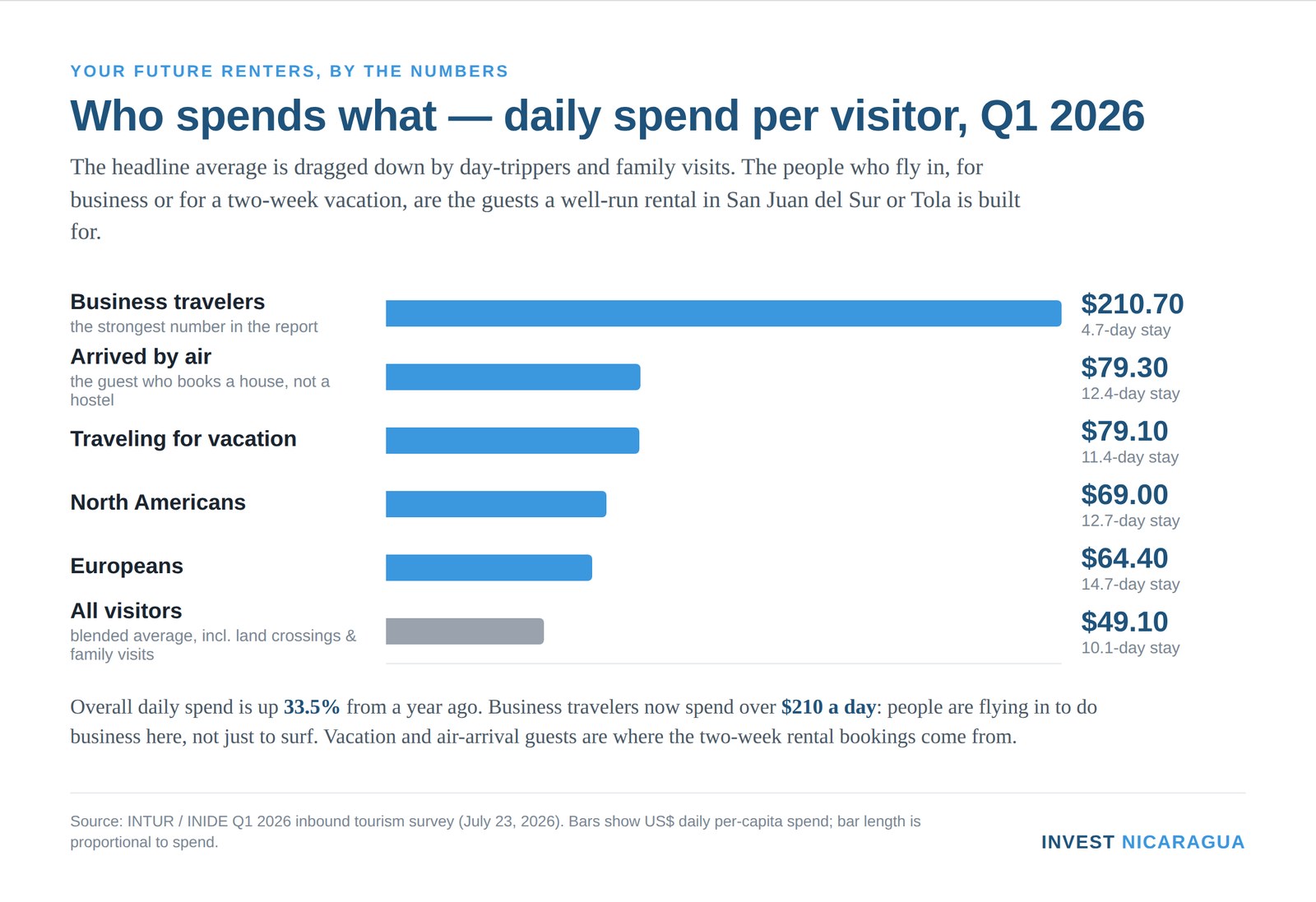
Business travelers spend $210.70 per day. That is the single strongest figure in the report, and it says something about where Nicaragua stands today: people are flying in to do business here, not only to surf. Visitors arriving by air spend $79.30 per day and stay 12.4 days. Vacation travelers spend $79.10 per day over 11.4 days. North Americans spend $69 per day and stay nearly two weeks. Europeans stay the longest, almost 15 days.
| Visitor segment (Q1 2026) | Daily spend (USD) | Average stay |
|---|---|---|
| Business travelers | $210.70 | 4.7 days |
| Arrived by air | $79.30 | 12.4 days |
| Vacation travelers | $79.10 | 11.4 days |
| North Americans | $69.00 | 12.7 days |
| Europeans | $64.40 | 14.7 days |
| All visitors (blended average) | $49.10 | 10.1 days |
We have said this for years, and now we have the government’s own survey to support it: the people flying into Managua and driving to the coast are not the $20-a-night backpacker crowd this town was known for fifteen years ago. They are couples, families, and business travelers spending real money over meaningful stretches of time, and they are precisely the guests a well-run ocean-view rental in San Juan del Sur or Tola is designed for. Our cost of living guide shows what that money buys once you live here.
One further point. We are aware that some people question whether government tourism figures are accurate. We cannot audit INTUR. What we can do is report what we observe directly, and every one of those signals points in the same direction as the official data: hotels full on peak dates, both international schools in San Juan del Sur adding students, more construction underway between San Juan del Sur and Tola than at any point since we have been here, and our own transaction count doubling. If the official numbers are off, they are off in the conservative direction.
The Canadians are coming, officially
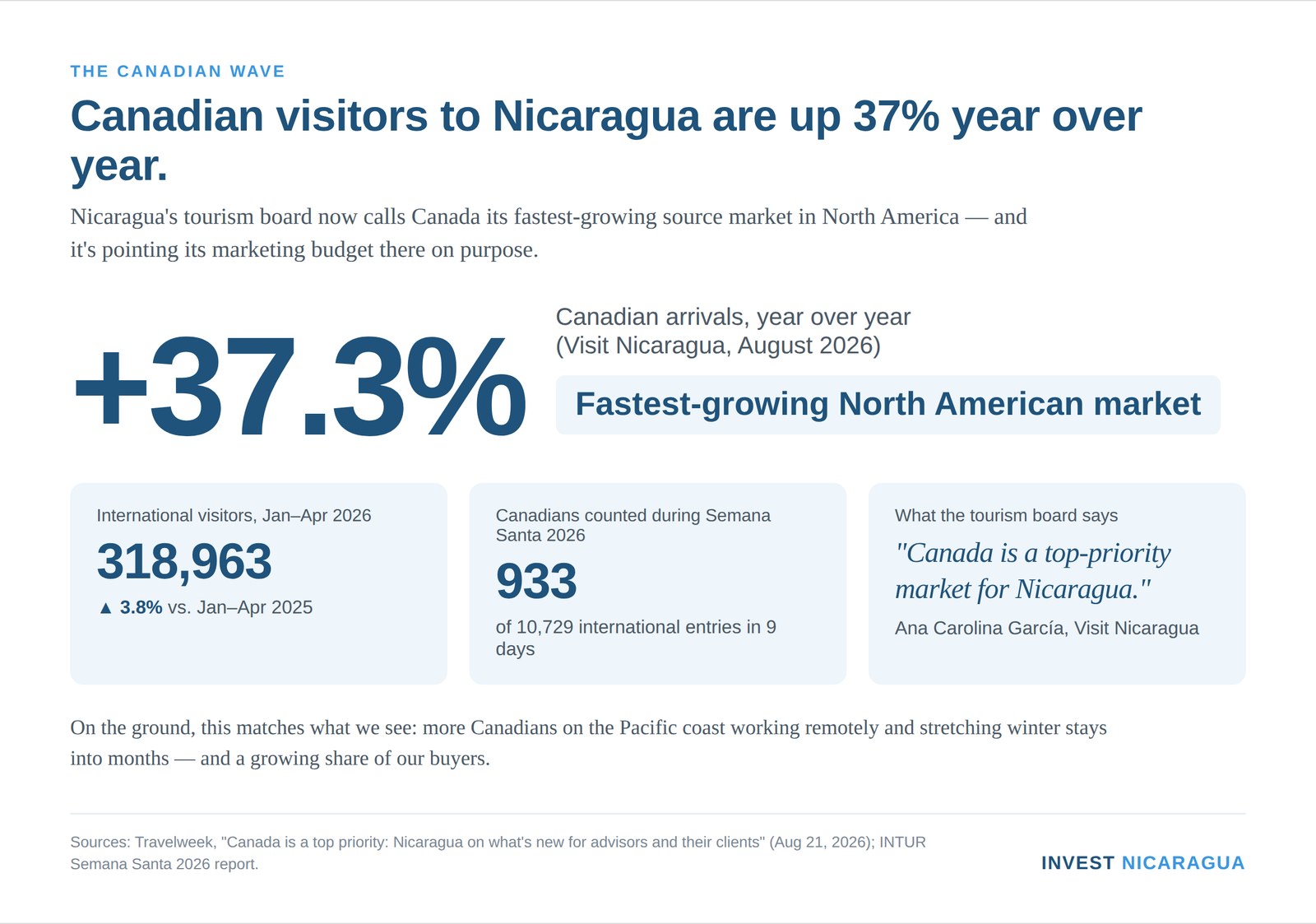
In our market updates we have consistently highlighted the rapid growth of Canadian clients coming to Nicaragua, specifically to San Juan del Sur and Tola. In August, the tourism board put a number on the visitor side of that trend: Canadian arrivals are up 37.3% year over year, making Canada the fastest-growing source market in North America. Their director of international promotion told a Canadian trade publication that “Canada is a top-priority market for Nicaragua,” and the board has launched a certification program to equip Canadian travel advisors to sell the country.
On the ground this looks the way it sounds. Canadians who used to come for two weeks in February are now coming for two months and working from here. The snowbird pattern is well established: retirees and entrepreneurs who spend the entire North American winter on this coast, November through April, and return home for the summer. A growing number of them are our clients.
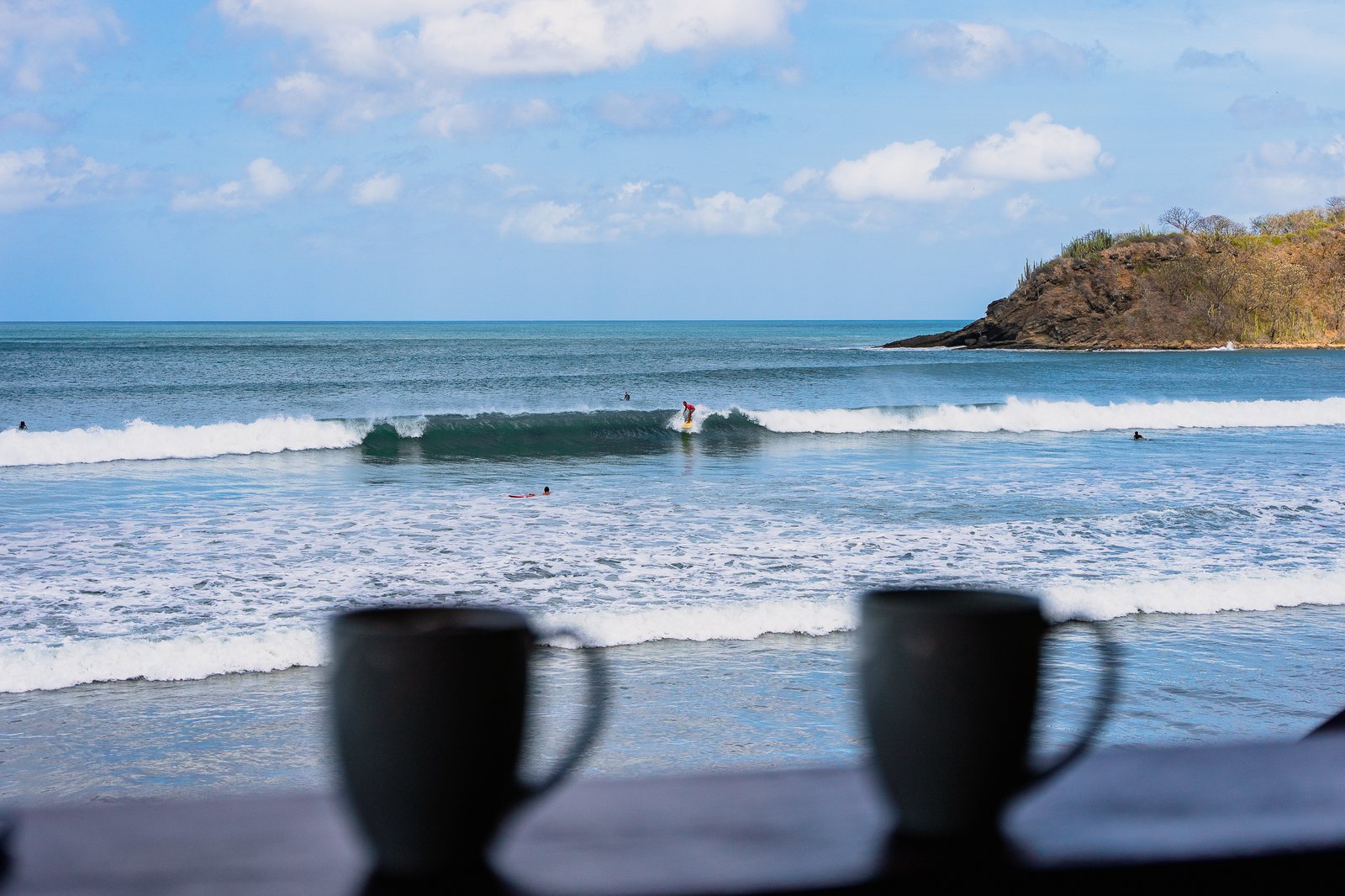
The interest makes sense when you consider how far a Canadian dollar goes here versus at home, where real estate prices have skyrocketed and stricter financial regulations have Canadian citizens looking abroad. Not to mention the brutal winters. Set that against extremely affordable real estate, a low overall cost of living, a picture-perfect climate, and a high quality of living, and the reasons behind the numbers are obvious.
Infrastructure: the road after the road
The single biggest story in last year’s report was the Costanera, the $400 million coastal highway that connected the beaches of San Juan del Sur to the beaches of Tola for the first time. That project is essentially complete, and it has done exactly what we said it would: shortened every drive, opened up land that previously required a 4×4, and merged two separate markets into one.
For evidence that the highway changed daily life and not merely drive times, look at the schools. Both international schools in San Juan del Sur, the San Juan del Sur Day School and Tambran International School, saw a significant increase in new students this year, including families living in Tola. The Day School added Rancho Santana as the first stop on its bus route: pick up in Tola, travel south along the coast past every major area, and arrive in San Juan del Sur. A year ago that commute did not exist. That is the coastal highway in action.
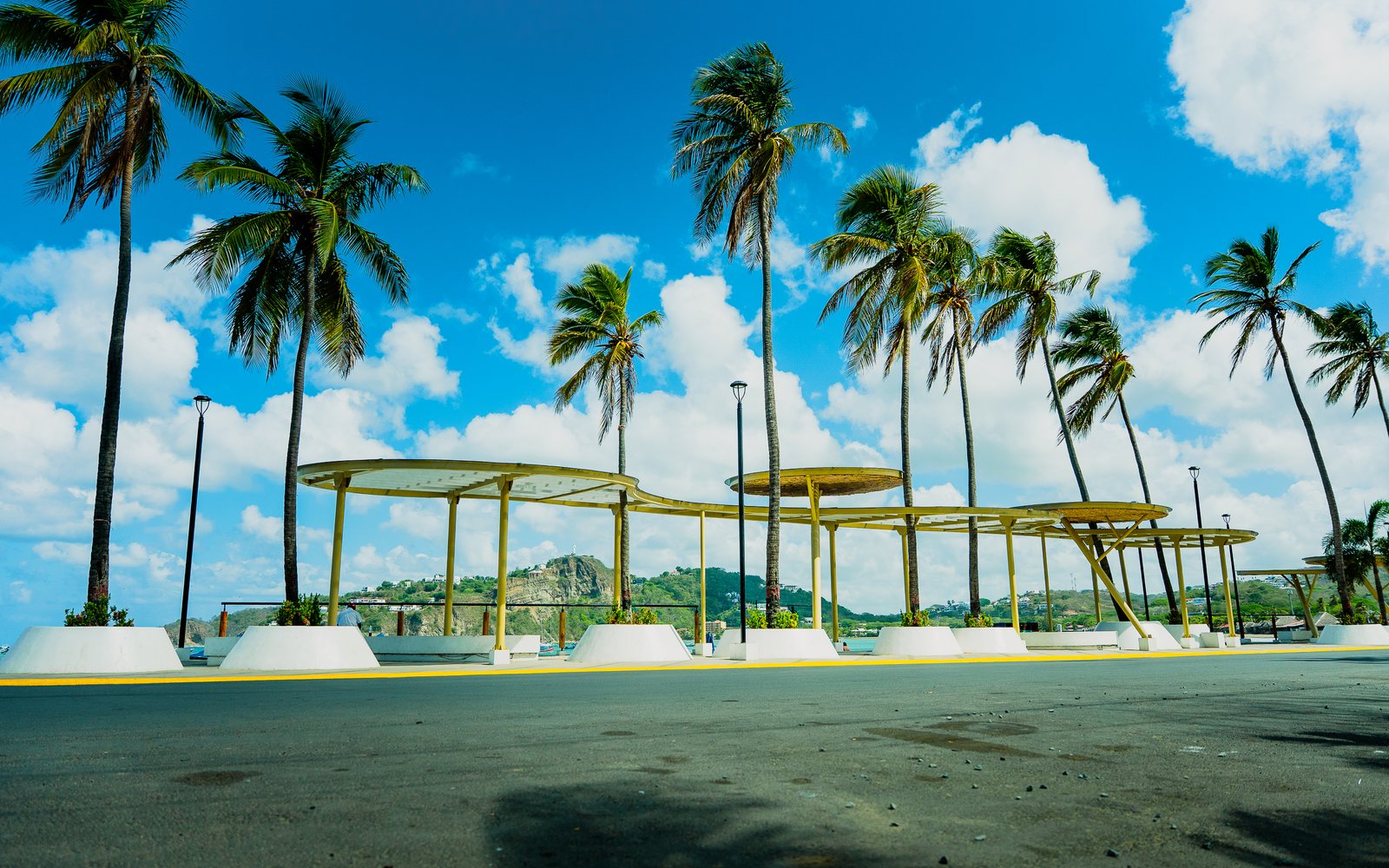

This year the story is what comes next. In March, CABEI, the same development bank that funded the Costanera, announced $230 million for five additional road projects, with construction beginning in October and November. To be clear, none of these projects sit on the main route most of our buyers take from the Managua airport, which runs through Masaya to Rivas and is already in excellent condition. One of them is worth watching, however: the 13-kilometer Diriamba–Jinotepe bypass, a $33 million project on the alternative route through Carazo that joins the Pan-American at Nandaime, just north of the Ochomogo bridge and the northern entrance to the Costanera. Once complete, it may become the faster route into Tola from the airport.
We raise this because what quietly changes a real estate market is rarely a single project. It is the pattern of a government and its lenders continuing to put money into the ground, year after year, in the direction of the coast.
Now, our own books
Our own books tell the story of continued strength through 2026, and they are the one part of any Nicaragua real estate market update that we can verify line by line.
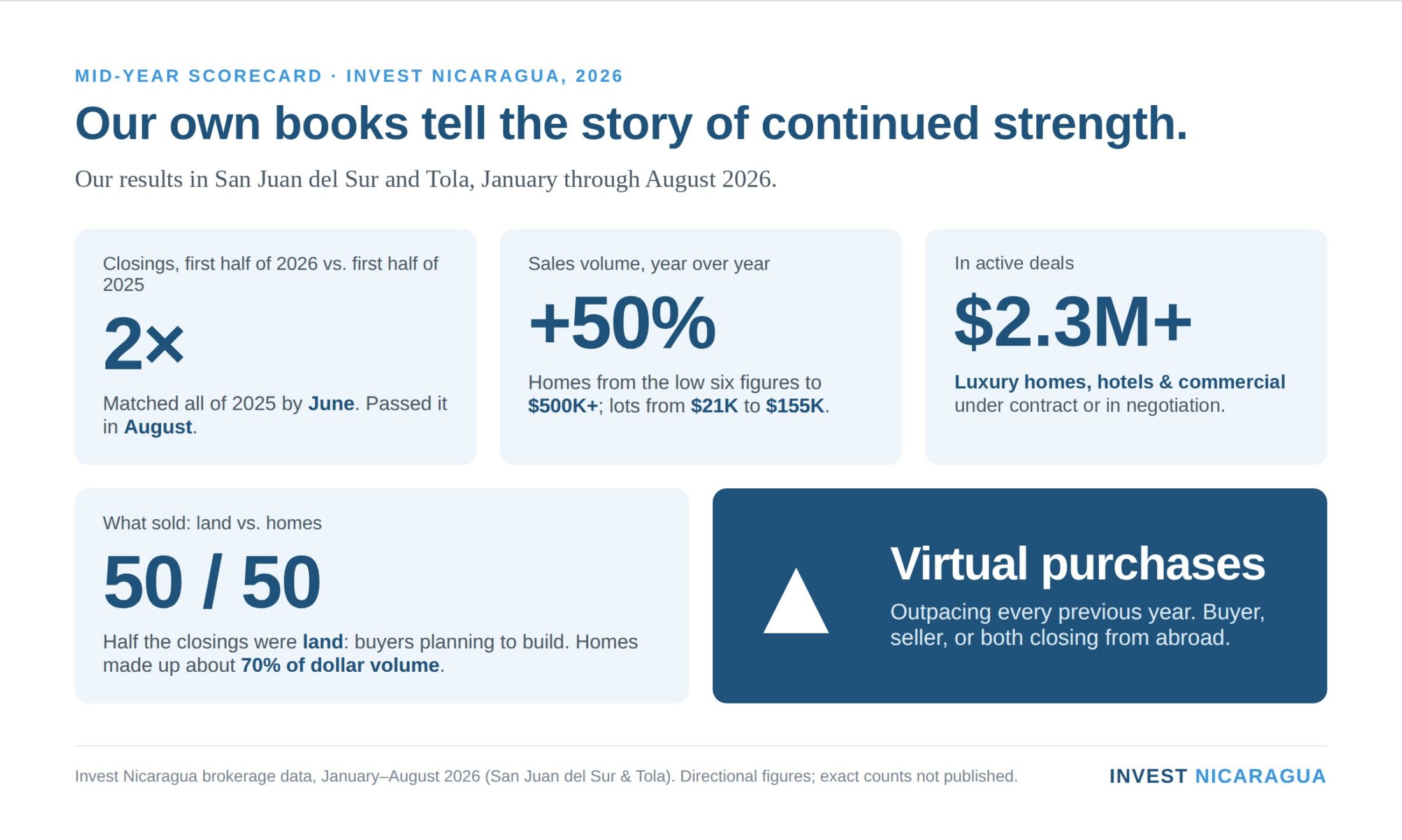
Closings in the first half of 2026 doubled compared to the first half of 2025. By June we had matched our entire 2025 transaction count; by the end of August we had surpassed it. Sales volume is up roughly 50% year over year. Homes closed from the low six figures to $500,000-plus, and luxury homes, hotels, and commercial properties in the high six figures to seven figures are under active negotiation.
One statistic from our own records that we find telling: approximately half of this year’s closings were land. Lots from the low $20,000s into six figures, purchased by buyers who intend to build. Homes accounted for the other half of the transactions and roughly 70% of the dollar volume. That split says two things at once. Turnkey homes are what move the money, and a considerable number of buyers surveyed the inventory, did not find their home, and decided to build it. Those are the new builds you will see going up between San Juan del Sur and Tola this winter.
Was the January prediction correct? On demand, yes, and by more than we expected. Where we were wrong was in assuming the surge would resemble 2021 and 2022, when it consisted mostly of people who had already visited and were ready to commit on the spot. This year, virtual purchases are outpacing every previous year.
Buying from abroad: not for everyone, but we have built for it
More of this year’s transactions closed with the buyer, the seller, or both outside the country for the entire process than in any year we have operated. Here is one from June.
A buyer in Germany reached out through one of our marketing platforms about a two-bedroom surf house near Playa Maderas. She had never been to Nicaragua. After a brief exchange we scheduled a proper call, and on that call we walked through the buying process, the legal framework for foreign purchasers, and what a virtual purchase would look like should she choose that route. Two or three months later she flew down for a surf camp, and we met once to view the property. We spent perhaps two hours together. We toured the house, talked about Nicaragua, talked about Germany, and talked through the process. Before she left, we introduced her to an attorney we have worked with for years, and she executed a limited power of attorney. A few days after returning to Germany, she submitted an offer. From that point, the entire transaction was conducted remotely: negotiation, due diligence, escrow, and closing. The seller, as it happens, was living abroad in Europe as well.
What made it seamless was not technology. It was communication. Every step was explained before it occurred, the right expectations were set, and by the time she was back in Germany there was genuine trust on both sides. She has not returned since closing. We arranged a property manager, the home is looked after, the camera system is active, and we are waiting on her to come down for a celebratory dinner. We have documented how the mechanics work, step by step, in Buying Property in Nicaragua Remotely.
If a client tells us they would never buy a home they have not stood in, our honest answer is that they probably will not, and that is entirely reasonable. A virtual purchase is not for everyone. The clients who pursue one are typically already comfortable with the idea, either because they have done it before or because they have purchased several properties at home and understand that most North American and European transactions are effectively virtual after the viewing occurs. Out-of-state investors. Buyers acquiring property in a neighboring country. There is a certain client who operates comfortably in that space, and we have the infrastructure, the communication standards, and the legal framework to complete the transaction without a hiccup. We have done it dozens of times.
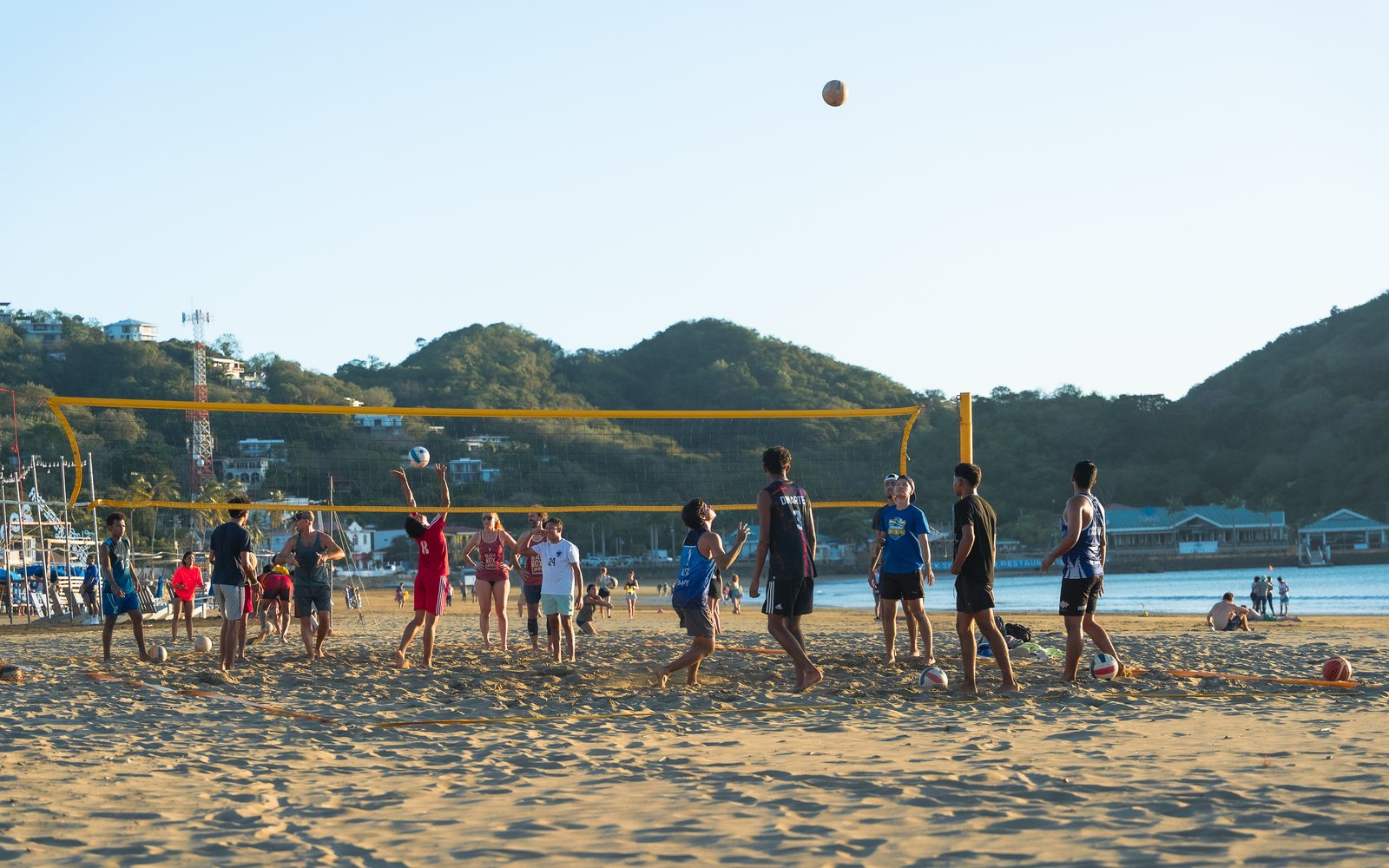
For everyone else, the traditional approach works exactly as it always has: come down, see the property, then decide. Some clients fall in between, viewing in person and closing from home. Whatever suits the client is the path we take, and adapting to what each client needs is a significant part of what distinguishes us. If you are comfortable buying from abroad, we know how to get it done. If you would rather stand in the living room first, we look forward to seeing you here.
Why September beats January
Here is the arithmetic that should matter to anyone seriously considering a purchase in the next twelve months.
Demand doubled. Inventory did not. The pool of what we would call the highly desirable, truly turnkey homes, three or four bedrooms, ocean view, pool, good road access, modern or recently updated, is smaller today than it was a year ago, because those are the homes that sold. There is still no large-scale development pipeline producing twenty of them at a time; supply here comes from individual owners deciding to sell, and roughly 90% of them own outright, with no pressure to discount.
Now layer high season on top of that. From Thanksgiving through Semana Santa, every buyer who has been considering this all year is here at the same time, touring the same short list of homes, and sellers know it. Good listings go under contract quickly. Prices firm up. It is the most competitive stretch of the year, every year.
If you are going to buy within the next twelve months regardless, the prudent move is to do so before the crowd arrives. Close in September or October and your property is furnished, managed, and taking bookings when the December wave of two-week guests lands, rather than you being one more buyer in that wave, competing against everyone else.
If you own property here and have been considering a sale, read the paragraph above again from the other side of the table. This is the kind of demand you list into. Our Sell Your Property page explains how we approach it.
Our prediction for next year
We expect this high season, Thanksgiving 2026 through Semana Santa 2027, to bring continued growth in interest and activity at a faster, compounding rate than any period since COVID.
The reasoning is as follows. Last high season was the first in which visitors saw the largely completed coastal highway, and it generated considerable buzz. Nicaraguans from across the country, international tourists, buyers, and sellers were all driving it for the first time. That momentum is what has carried us into September. The highway in this region is now complete, so this winter we expect the same people to return, along with the people they told: “I was in Nicaragua last winter; you have to see the coastal highway.” Those who came last year will also see the visible growth of the past eight or nine months with their own eyes. Larger student bodies at the Day School and Tambran. Children riding the bus from Rancho Santana to school in San Juan del Sur. New construction underway in Remanso, El Encanto, Maderas, and elsewhere. Land opening up in Brito and in areas between San Juan del Sur and Tola that simply were not accessible before.
Then consider the broader picture. The cost of living in North America and Europe remains very high. Inflation is still moving up. Multiple wars are ongoing. For many people, quality of life no longer matches the cost of living. As those external pressures continue to disrupt daily life, particularly economically, more people will look beyond their home countries to Nicaragua and the rest of Central America and conclude that they can live here for far less, purchase real estate at a fraction of the cost, live by the beach in an excellent climate, enroll their children in an internationally accredited school, and enjoy a substantially higher quality of life without the turmoil, the safety concerns, and the expense that most people are contending with at home.
If this year finishes as strongly as we expect, 2027 sets up as an even stronger, compounded year, driven by families relocating to San Juan del Sur and Tola and enrolling their children in the international schools; entrepreneurs who work remotely and are not required to be in their home country twelve months a year; retirees who recognize that their money goes considerably further here, including access to quality healthcare at a reasonable cost; and investors watching the government and its lenders double down on infrastructure and position the southern Pacific coast as one of the most desirable areas in the region, if not the most desirable.
Our view is straightforward. If you have been looking to buy, now is the time. Going forward, we expect less inventory and firmer, if not higher, prices. We will grade this prediction in January, alongside the rest of this 2026 Nicaragua real estate market update.
Make your move
If you have been on our list for a while, you already know the country, you have likely already chosen a region, and you have been waiting for the right moment. We would argue this is it. Start with the full picture of Nicaragua real estate across San Juan del Sur and Tola, then narrow it to the homes, land and condos for sale that match your brief.
Tell us what you are looking for and your budget, and we will send you what actually fits, not the entire website. Common questions are answered on our FAQ page and in the First-Time Buyer’s Guide. If you cannot be here, we will be your eyes, on video, on the property, as many times as it takes. If you would prefer to see it in person first, let us get you here in October, ahead of the rush.
Set up a free consultation: Book a call
Email: leslie@investnicaragua.com
WhatsApp: +505-7828-7020
We look forward to seeing you at the beach.
Frequently asked questions
Is the Nicaragua real estate market a good investment in 2026?
Based on our brokerage data and national tourism figures, 2026 has been the strongest year on Nicaragua’s southern Pacific coast since COVID. Tourism revenue grew 40.1% in the first quarter, Canadian arrivals are up 37.3%, and our own closings doubled year over year. Prices have appreciated steadily rather than speculatively, roughly 90% of owners hold property outright, and there is no large-scale development pipeline adding supply, which supports firm pricing. As with any market, the right property depends on your goal: rental income, relocation, a land hold, or a Plan B.
How much does a home cost in San Juan del Sur or Tola in 2026?
In 2026 we have closed homes from the low six figures to over $500,000, with luxury homes, hotels, and commercial properties in the high six to seven figures under active negotiation. Turnkey three- to four-bedroom ocean-view homes with a pool typically fall in the $300,000 to $500,000 range. Lots start in the low $20,000s and run into six figures for beachfront or large acreage.
Can a foreigner buy property in Nicaragua without visiting?
Yes. Foreigners have the same property rights as Nicaraguan citizens, and a purchase can be completed remotely using video walkthroughs, an electronically signed Private Sales Agreement, independent legal due diligence by your own attorney, a fully bonded and insured escrow, and a limited power of attorney for closing. Many buyers visit once before committing; some never visit before closing. The traditional in-person process remains available for those who prefer it.
Are Nicaragua’s tourism numbers reliable?
The figures in this report come from INTUR and INIDE, Nicaragua’s tourism institute and national statistics office. We cannot audit them independently, but the on-the-ground indicators we observe directly, including full hotels on peak dates, rising enrollment at both international schools in San Juan del Sur, record construction activity between San Juan del Sur and Tola, and our own doubled transaction count, all point in the same direction.
Is it better to buy before or during high season?
Before. From Thanksgiving through Semana Santa, buyer competition peaks, sellers firm up on price, and the best turnkey listings go under contract quickly. A buyer who closes in September or October has a furnished, managed property taking bookings when December guests arrive, rather than competing with every other buyer touring in January.
When is the full 2026 market report published?
Our full annual Nicaragua real estate market report is published each January. This mid-year update will be graded against actual results in the January 2027 report.
About the author: Leslie W. Stewart IV is the founder and Broker of Record of Invest Nicaragua (INVUR License No. 0024-2023). He came to Nicaragua with the Peace Corps in 2011 and has lived on the Pacific coast since, closing hundreds of transactions in San Juan del Sur and Tola. Market observations in this report are drawn from Invest Nicaragua brokerage records, January–August 2026; national figures are cited from the sources below.
Sources
- Instituto Nicaragüense de Turismo (INTUR) / INIDE — Comportamiento del turismo receptor en primer trimestre de 2026 (July 23, 2026)
- Travelweek — Canada is a top priority: Nicaragua on what’s new for advisors and their clients (August 21, 2026), interview with Ana Carolina García, Visit Nicaragua
- Global Highways — $230 million for five road projects in Nicaragua (March 2026); Central American Bank for Economic Integration (CABEI)
- Invest Nicaragua brokerage data — San Juan del Sur & Tola, January–August 2026
- Invest Nicaragua — 2025 Market Report (March 2026) and Cost of Living Guide (2026)